What is the Pilates Reformer? Fundamentals and benefits for your body and posture
Explanatory article: what is the Pilates Reformer and its benefits
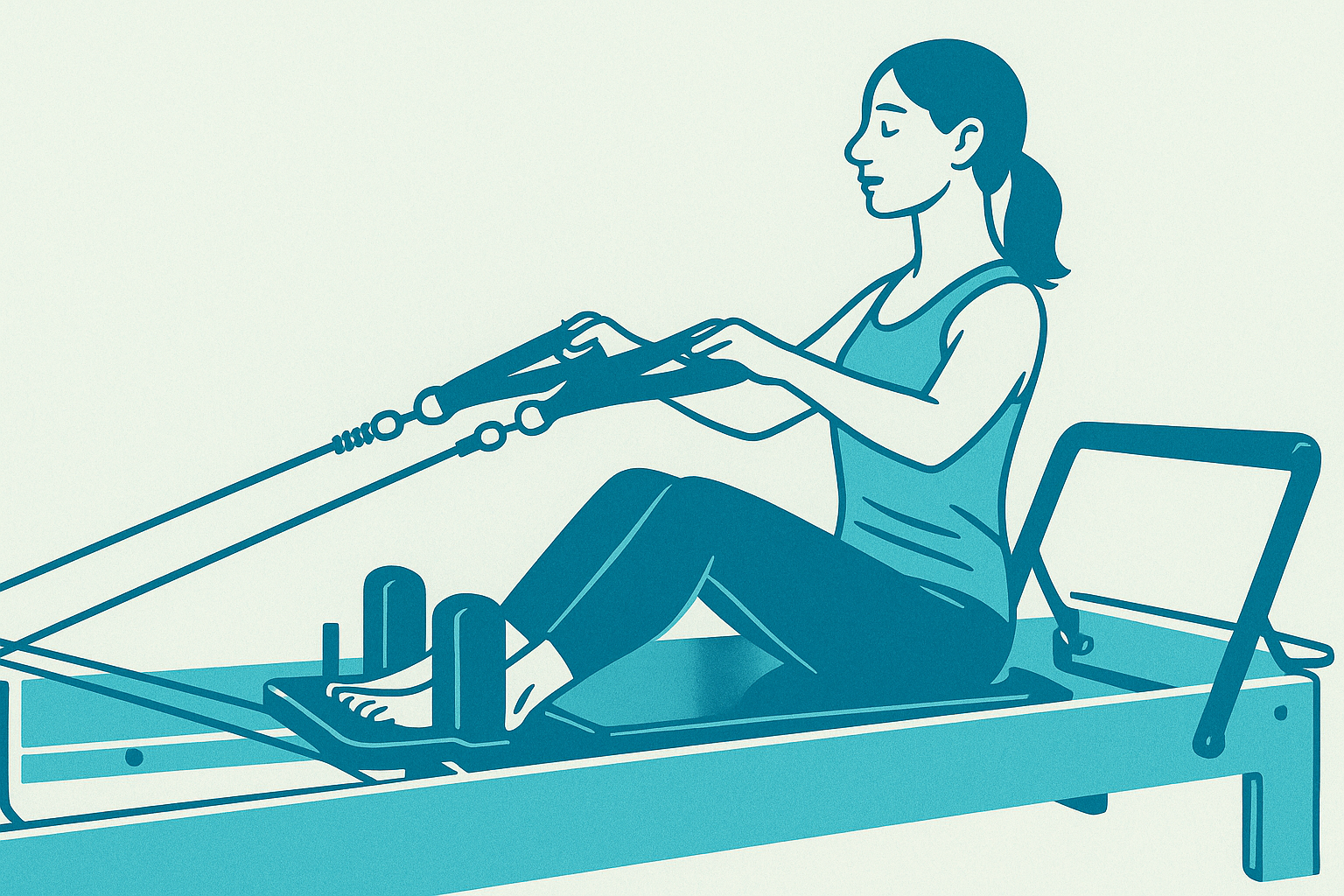
What is the Pilates Reformer?
The Reformer is a Pilates machine consisting of a sliding carriage, springs of varying strength, straps and a FOOTBAR. Its design allows assist or challenge movement to train with precision, postural control and breathing.
In contrast to the mat, the Reformer offers immediate feedback about your alignment and a range of options to safely progress from beginner to advanced levels or therapeutic work.
How it works: carriage, springs and guides
Sliding carriage
It moves on smooth rails. Helps you to perceive symmetries and compensations while working on strength and control.
Springs
They change the resistance to attend (support) or challenge you (strength). Small adjustments transform the exercise stimulus.
Straps and bar
They expand the repertoire for upper and lower limbs, facilitating safe and coordinated ranges.


Main benefits of the Pilates Reformer
1) Posture and core
Strengthens the core and improves alignment of the spine, shoulder girdle and pelvis. Ideal for back pain and postural work.
2) Elegant strength
Build strength and flexibility with control. It's not “more weight”, it's better mechanics and quality of movement.
3) Safe mobility
The springs control the effort to extend ranges with stability and without aggression.
4) Awareness and breathing
Rhythm, focus and breathing are integrated to lower tension and improve daily performance.
5) Measurable progress
Varying springs, angles and supports allows for clear objectives and monitoring progress.
6) Versatility
It works for beginners, athletes, pregnant women and older people with specific adaptations.
“When the body understands the correct movement, the force appears with less effort”.”
Who is it for?
- Beginners seeking to learn the technique with support.
- People with back problems or sedentary posture.
- Athletes who want control and stability to perform better.
- Pregnancy and postpartum with safe adaptations per quarter.
- Major who need smooth mobility and balance.
How to get started safely
- Assessment or initial class: we review objectives, history and level.
- Fundamentals: breathing, positioning of pelvis and scapulae, activation of the centre.
- Progression: we increase ranks and endurance when the technique is clean.
- Constancy: 1-3 times per week for stable changes.
Ready to give it a try? See Reformer classes o book a first session.
Frequently asked questions
Is it better to start with the Reformer or the floor?
It depends on the objective. The Reformer guides technique; the mat consolidates control and breathing. We can assess this in your first session.
How many sessions per week?
Between 1 and 3, depending on your level and recovery. Regularity is the key.
Can I practice with back pain?
Yes, with adaptations and supervision. If there is persistent pain, we recommend Therapeutic Pilates to begin with.